
Outdoor learning environments are central to high-quality early childhood education in Australia. When these spaces are designed with natural play elements, they do far more than provide physical activity — they actively support children’s learning, wellbeing, and connection to the world around them.
The Early Years Learning Framework (EYLF) clearly recognises the value of nature-based learning, sustainability, and environments that invite curiosity and imagination. Outdorable’s approach to outdoor play — grounded in natural materials, thoughtful design, and environmental responsibility- aligns strongly with both the language and intent of the EYLF.
The EYLF positions children as capable, curious learners and recognises the environment as a key contributor to learning. Outdoor spaces are described not as secondary to indoor learning, but as essential learning settings in their own right.
The framework states:
“Outdoor learning spaces are a feature of Australian learning environments. They offer opportunities for children to explore, experiment, move and learn.”
(EYLF: Belonging, Being & Becoming)
Natural play environments.. those rich in timber, texture, variability and connection to the living world, support this vision by offering open-ended experiences rather than prescriptive play outcomes. These environments encourage children to investigate, take appropriate risks, collaborate, and create their own meaning through play.
Outdorable’s play elements are intentionally designed to support child-led exploration, reflecting the EYLF’s emphasis on play as a vehicle for learning.
Sustainability is embedded throughout the EYLF, particularly within Outcome 2: Children are connected with and contribute to their world.
The framework states that children should:
“Become socially responsible and show respect for the environment.”
(EYLF Outcome 2)
It further explains that children develop understanding when they:
“Become aware of the impact of human activity on environments and the interdependence of living things.”
Natural outdoor environments provide children with authentic opportunities to experience sustainability in action. Material choice plays a crucial role in this learning.
Outdorable’s use of Accoya® modified wood — a renewable, non-toxic, Cradle to Cradle Certified® GOLD material, offers a tangible expression of sustainable values. Rather than relying on plastic-based materials, natural timber allows children to interact daily with a material that is renewable, low-carbon, and responsibly sourced.
This supports the EYLF’s emphasis on meaningful, lived experiences of sustainability, rather than abstract concepts.
The EYLF recognises that a strong connection to nature supports children’s wellbeing, sense of belonging, and emotional development. It states:
“Children develop an understanding of their place in the natural world.”
(EYLF Outcome 2)
Natural play environments are associated with calmer engagement, deeper focus, and richer imaginative play. Elements such as timber, natural textures, organic forms, and exposure to seasonal change help create spaces that feel grounded and responsive.
Outdorable’s designs intentionally avoid overly industrial or plastic-heavy aesthetics. Instead, they support environments that feel human-scaled, warm, and connected to place, qualities that are particularly important in early learning settings.
The EYLF places strong value on environments that foster curiosity, creativity, and inquiry. It states:
“Children learn through play, curiosity, imagination and discovery.”
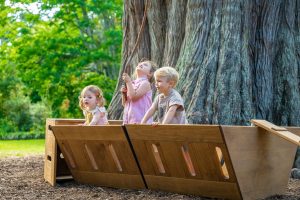
Natural materials are inherently open-ended. A timber beam may become a balance challenge, a gathering place, a bridge, or a storytelling prompt, depending on the child and the moment.
Outdorable’s play elements are designed to:
Encourage multiple uses rather than fixed functions
Support collaborative and social play
Adapt to different ages and developmental stages
This approach aligns strongly with Outcome 4: Children are confident and involved learners, where children are supported to experiment, problem-solve, and persist.
The EYLF also recognises the importance of environments that support children’s health, safety, and physical wellbeing:
“Children are supported to take increasing responsibility for their own health and physical wellbeing.”
(EYLF Outcome 3)
In Australian outdoor environments, material choice has practical implications. Natural timber surfaces generally remain cooler to the touch than many plastic alternatives in direct sun, contributing to comfort and safety in high-UV conditions.
By designing with climate-responsive materials, Outdorable demonstrates an understanding that quality learning environments must respond to place, climate, and context, a key consideration in Australian early childhood settings.

Outdorable’s philosophy and material choices align with the EYLF across multiple outcomes:
Nature-based, child-led play experiences
Authentic sustainability embedded in material selection
Strong connection to the natural environment
Open-ended learning opportunities
Environments that support wellbeing and safety
As the EYLF reminds educators:
“The environment is a powerful teaching tool.”
By choosing natural, sustainable play elements, early learning services are not only meeting the expectations of the EYLF, they are creating outdoor environments where children can genuinely belong, be, and become.